
African Americans and
The First Memorial Day Celebration
Memorial Day, the USCT, and the Black Americans Who Remembered First
Do you know the story of African Americans and The First Memorial Day Celebration. There are some graves America remembers with marble, flags, and ceremony.And then there are others. Graves that began as trenches. Bodies placed quickly into the earth.
Names unspoken. Families never notified. No proper prayer.
No final honor. No mother, wife, child, or loved one standing close enough to say goodbye.
For many Black soldiers who served in the Civil War, death did not always bring dignity. Even after fighting for the Union, even after risking their lives for a country still deciding whether it would recognize their humanity, many were buried without ceremony, without markers, and without the honor they had earned.
But history has a way of waiting. It waits beneath the soil. It waits in old newspaper clippings. It waits in family stories passed down when official records fall silent.
And in Charleston, South Carolina, in the spring of 1865, newly freed African Americans did something extraordinary. They remembered. They took a place of suffering, a former racetrack turned Confederate prison camp, and transformed it into sacred ground.
Today on Quarter Miles Travel, we uncover the overlooked Black history of Memorial Day, the United States Colored Troops, and the freed men, women, and children who insisted that the soldiers who died for Union and liberty would not be forgotten.
The Civil War was America’s deadliest conflict. Approximately 620,000 soldiers died, and about two-thirds of those deaths came not from bullets, but from disease.
The country was broken. Families were shattered. Towns were emptied of sons. And across the South, the war did more than destroy buildings and battle lines, it shook the foundation of slavery itself.
For enslaved people, the Civil War was not simply a war between North and South. It was a war that opened a door. A dangerous door, yes but one that led toward freedom.
As Union forces moved through Southern states, enslaved men, women, and children made life-changing decisions. Some fled plantations. Some followed Union troops. Some entered contraband camps. Some joined the army. Some searched for relatives who had been sold away. And some simply tried to survive long enough to see what freedom might become.
And then came the United States Colored Troops – the USCT.
Black men enlisted to fight for the Union at a time when the country still refused to treat them as equals. They wore the uniform. They carried the flag. They faced Confederate bullets, disease, discrimination, and the knowledge that if captured, they could be treated far worse than white soldiers.
They were fighting for the Union. But they were also fighting for something deeper.
They were fighting for freedom with their bodies, their courage, and their names.
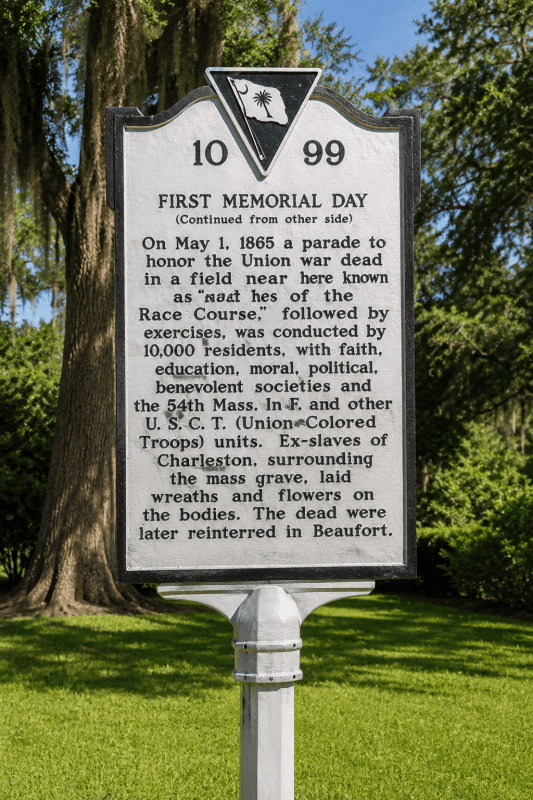
In Charleston, South Carolina, during the final year of the war, Confederate forces turned the Washington Race Course and Jockey Club into a makeshift prison camp for captured Union soldiers. It had once been a place of leisure and wealth — a racetrack connected to the world of planters and privilege. But during the war, it became a place of suffering.
At least 257 Union prisoners died there, many from disease and exposure. Their bodies were buried quickly in unmarked graves near the racetrack. No proper ceremony. No lasting dignity. Just a mass grave behind the grandstands.
Then Charleston fell. The Confederate army evacuated the city. And the people who remained included thousands of newly freed African Americans — men, women, and children who understood exactly what those Union soldiers represented.
To them, these were not nameless bodies. These were men who had died in a war that helped destroy slavery. So the freed people of Charleston acted.
In the days leading up to May 1, 1865, roughly two dozen African American Charlestonians went to the site. They reinterred the bodies. They placed the graves in proper rows. They built a ten-foot-high white fence around the burial ground.
Over the entrance, they placed words that still carry power: “Martyrs of the Race Course.”
That phrase said everything. Created by a group called Friends of the Martyrs – A group of two dozen recently freed slaves who spent two weeks exhuming and reburying the bodies. And along with a group called the Patriotic Association of Colored Men
They knew these soldiers had not simply died. They had died for something. Both groups helped exhume these brave soldiers and form a committee to honor their service and their lives with ceremony.
On May 1, 1865, about 10,000 people gathered at the old racetrack in Charleston. Most were Black residents, newly freed people, joined by some white missionaries and teachers. The ceremony began in the morning.
Around 3,000 Black schoolchildren marched around the racetrack carrying flowers. Imagine that picture: children, many of them born into slavery, now walking freely, holding roses, singing “John Brown’s Body.”
Behind them came adults representing aid societies for freed Black men and women. Black pastors delivered prayers. Spirituals were sung. Sermons were preached.
Speeches were given by Union officers, missionaries, and Black ministers.
They sang patriotic songs, including “America,” “We’ll Rally Around the Flag,” and “The Star-Spangled Banner.” Later that afternoon, Black and white Union regiments marched around the graves and performed drills. Among them were members of the famed 54th Massachusetts Infantry, along with the 35th and 104th United States Colored Troops.
A celebration of honor – the first Decoration Day, which would later become Memorial Day.
The New York Tribune described the tribute as “a procession of friends and mourners as South Carolina and the United States never saw before.” The graves were covered in flowers. The air carried their fragrance. And people wept — not only in grief, but in joy.
Because this was more than a funeral. It was a declaration. Freed Black Americans were saying: These men mattered. Their sacrifice mattered. Freedom mattered. Memory mattered.
Historian David Blight later wrote that this tribute “gave birth to an American tradition.” In his words, Memorial Day had been founded by African Americans in a ritual of remembrance and consecration.
Now, here is where the story turns. Because this extraordinary ceremony — one of the earliest known Memorial Day observances in American history — was nearly erased.
For generations, the commonly accepted origin story of Memorial Day centered on General John A. Logan. In 1868, Logan, who led a Union veterans organization, called for Americans to decorate the graves of fallen soldiers on May 30. That national observance at Arlington National Cemetery became known as Decoration Day.
That story is important. But it was not the whole story. The Charleston ceremony happened three years earlier. So why didn’t most Americans learn it?
Because after Reconstruction ended, white Southerners reclaimed political power and reshaped public memory of the Civil War. The story many wanted to tell focused on reconciliation between white Americans — North and South — while leaving Black Americans and emancipation pushed aside.
The role of African Americans in founding an early Memorial Day did not fit that narrative.
And so, the memory faded. The racetrack became Hampton Park. The Union soldiers’ remains were later moved to Beaufort National Cemetery. The story of the freed people’s tribute slipped into archives, family memory, and old newspapers.
It was not until the late 1990s that historian David Blight found a file labeled “First Decoration Day” while researching at Harvard. Inside were references to newspaper accounts describing the May 1, 1865 ceremony.
There it was…. waiting. Proof that Black Americans had helped create one of the nation’s most sacred traditions.
To understand why this ceremony matters, we have to understand the USCT.
The United States Colored Troops were not side characters in the Civil War.
They were central to the Union victory.
Nearly 180,000 Black men served in the Union Army, and thousands more served in the Navy. Many were formerly enslaved. Others were free Black men from the North. They fought knowing the risks were enormous.
If captured by Confederate forces, Black soldiers could be executed, enslaved, or treated as criminals rather than prisoners of war.
And yet they served. They served at Fort Wagner. They served at Port Hudson.
They served at Petersburg. They served across the South and beyond.
Their families often followed the war in their own way — fleeing plantations, seeking refuge behind Union lines, building schools, churches, and aid communities wherever freedom began to take root.
For Black families, military service was not abstract. It was personal. A son joining the USCT might mean the first military uniform ever worn by a man in that family.
A husband fighting for the Union might mean a chance at freedom for his wife and children. A father carrying a rifle might mean his children could one day learn to read.
That is why burial mattered. That is why flowers mattered. That is why the freed people of Charleston stopped and honored those Union dead.
Because they understood the price of freedom better than anyone.
Today, travelers can still follow this story. Charleston is not only a city of beautiful architecture and coastal charm. It is also a city where the Civil War began, where slavery shaped wealth, and where newly freed people helped redefine the meaning of American memory.
Hampton Park now stands where the Washington Race Course once operated. Beaufort National Cemetery, where the soldiers were later reinterred, remains a place to reflect on sacrifice, service, and the complicated memory of war.
And across the country, Civil War sites tied to the USCT invite deeper exploration — not just of battle strategy, but of courage, family, freedom, and recognition.
This is what Quarter Miles Travel is about. Going beyond the surface.
Finding the stories that have been left out. Understanding that travel is not only about where we go, but what we are willing to remember when we get there.
Memorial Day is often marked with flags, parades, and long weekends. But beneath the tradition is a deeper story.
A story of soldiers buried without ceremony.
A story of freed people who refused to let them remain forgotten.
A story of Black children carrying flowers around a racetrack that had become a cemetery.
A story of prayer, song, dignity, and truth.
The freed people of Charleston understood something powerful:
Freedom requires memory. And memory requires action.
So when we honor Memorial Day, let us remember not only the soldiers who died, but also the people who first gathered to honor them — African Americans newly out of bondage, claiming their place as citizens, mourners, patriots, and keepers of history.
They brought flowers to the graves. And in doing so, they planted something much larger. A tradition. A truth.
And a reminder that the stories we recover can still change how we see America. They are all America’s stories.
Photos –
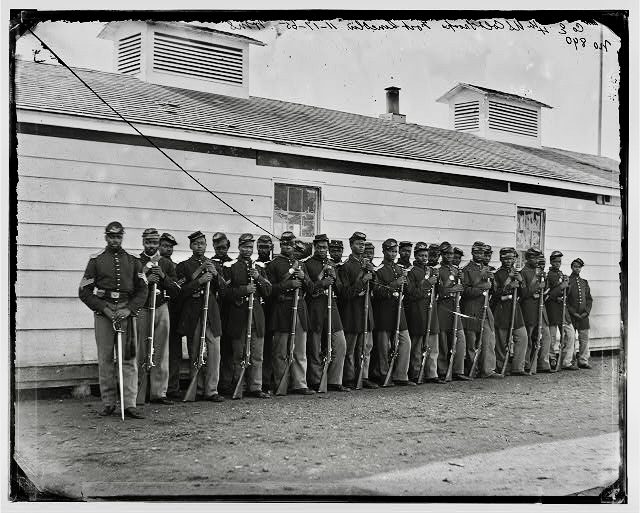
District of Columbia Company E, 4th U.S. Colored Infantry, at Fort Lincoln Photo Courtesy – Library of Congress
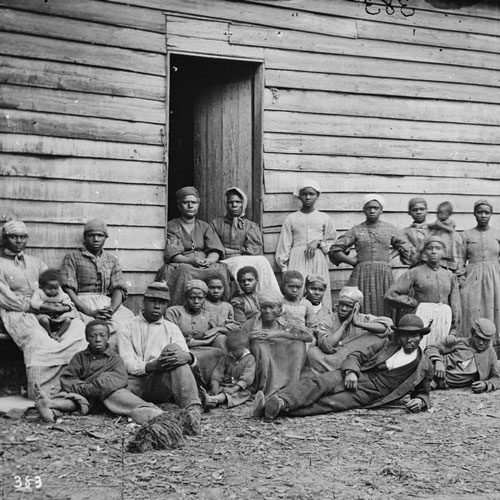
Group of contraband men, women and children at Foller’s house, 1862. Photo courtesy – Library of Congress
A note to understand the impact and importance of contraband camps –
During the Civil War in 1861, three enslaved men, Frank Baker, James Townsend, and Sheppard Mallory, escaped from Confederate-held Virginia and sought refuge at Union-held Fort Monroe. Refusing to return them to Confederate slaveholders, Union General Benjamin Butler declared them “contraband of war,” arguing that Virginia had seceded from the Union and the men could therefore be confiscated like enemy property. Butler’s decision helped create a new federal policy that allowed thousands of enslaved people to seek protection behind Union lines. The “contraband” decision became an important early step toward emancipation and eventually led to the Emancipation Proclamation and the abolition of slavery through the 13th Amendment in 1865.
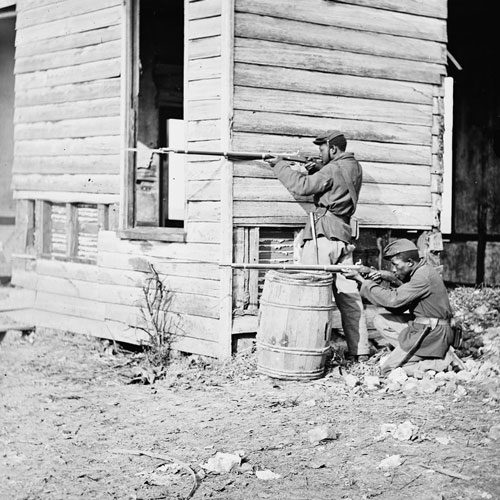
Picket station of US Colored Troops near Dutch Gap, Virginia- Nov, 1864 Photo courtesy – Library of Congress
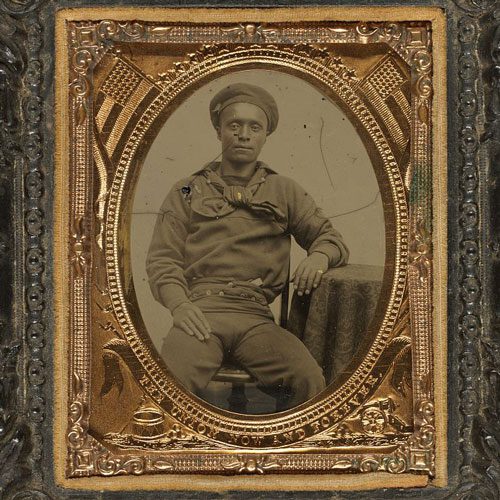
Brave African American sailor in Union uniform Photo courtesy – Library of Congress
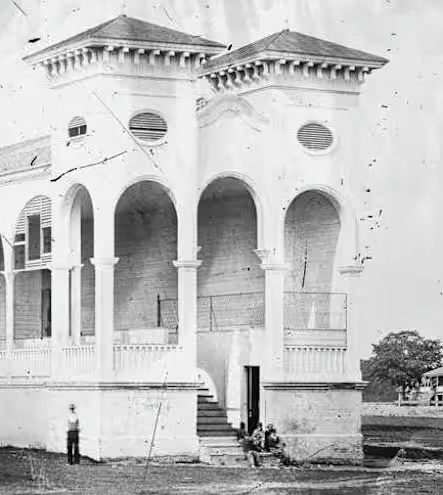
The Charleston racetrack clubhouse, location where the 1865 Decoration Day (Memorial Day) events took place.
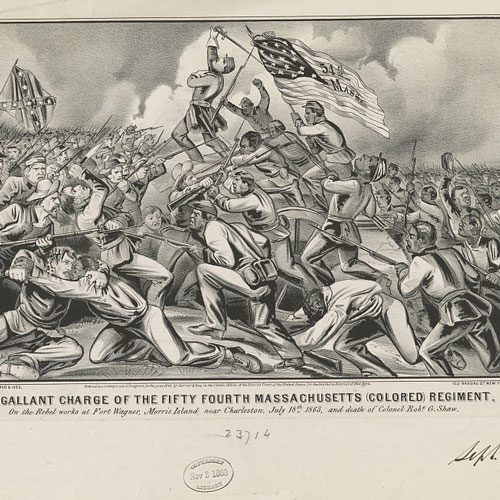
The gallant charge of the 54th Massachusetts – USCT regiment at Fort Wagner – July 18th 1863 – Photo courtesy – Library of Congress
Our commitment to storytelling –
Our goal is to journey through history in search of the untold and little-known stories — the ones overshadowed by larger narratives, pushed to the margins, or too often silenced and forgotten. We believe history is richest when all voices, experiences, and perspectives are explored with honesty and care.
We strive for accuracy, fairness, and thoughtful storytelling in every piece we create. Our work is grounded in research, historical records, oral histories, and cultural context. But we also recognize that history is not always fully preserved in written documents or official accounts. Sometimes it must also be understood through interpretation, lived experience, and the voices that history nearly lost.
Our commitment is to share these stories with integrity, insight, curiosity, and respect — bringing the past to life in ways that are meaningful, engaging, and thought-provoking.
And because history is always evolving through continued discovery and scholarship, we welcome thoughtful feedback. If you see something that may need correction, additional context, or if you have information that could deepen the story, we invite you to contact us at [email protected]
We value continued learning and will regularly review and update our content to ensure it remains as complete, accurate, and compelling as possible.
**Quarter Miles Travel is not associated with or in collaboration with the U.S. Mint. Our stories are inspired by the designs on our U.S. currency and does not reflect the opinions or views of the U.S. Mint.

0 Comments